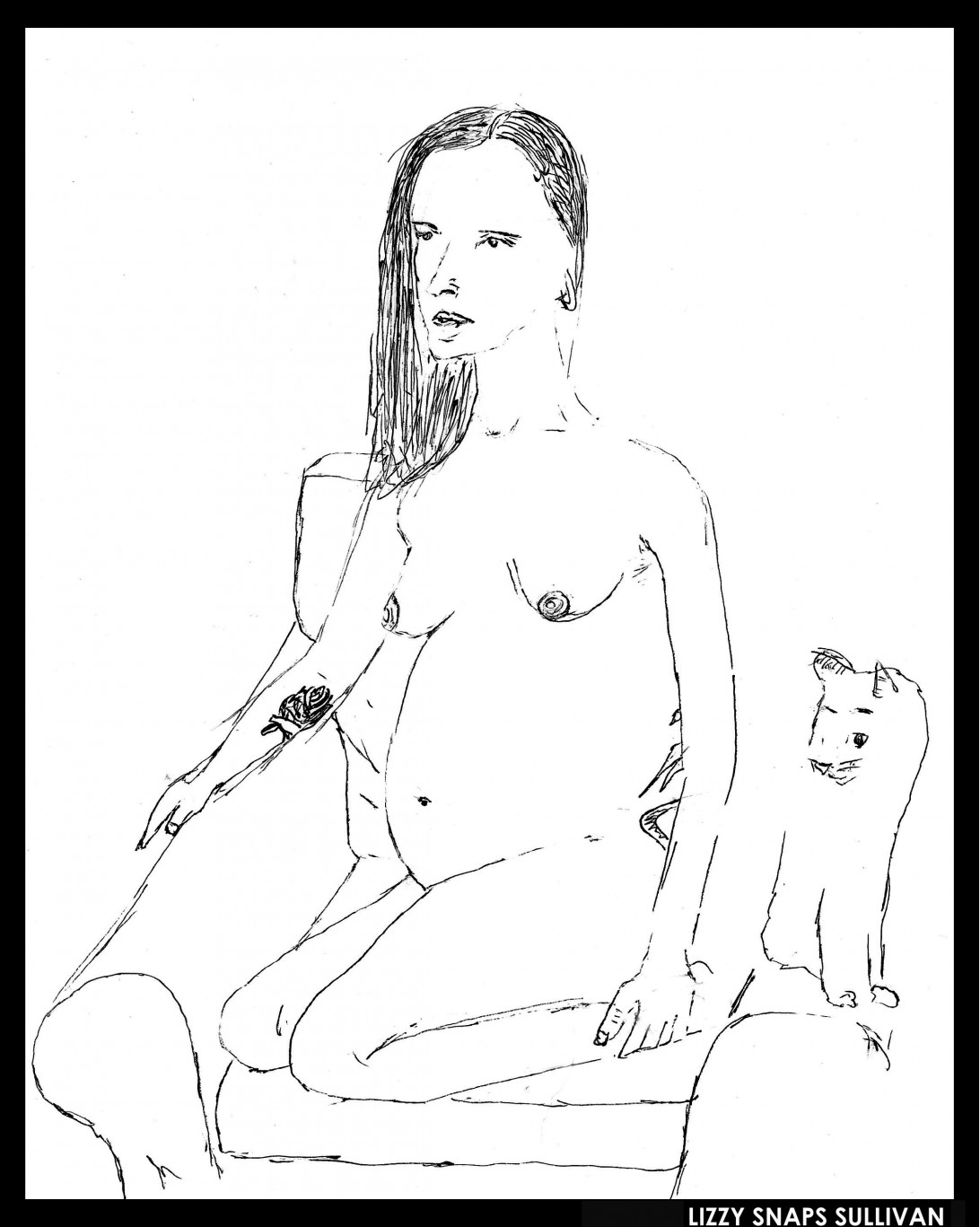
Week 30

I’ve become enchanted by the pelvic tunnel. After the cervix fully dilates–and wait, let me tell you that before the birthing videos and the dated computerized animation, I had this image of dilation as if the cervix was opening while the baby was suspended above waiting patiently, as if for a portal in a future space ship hallway that will open with a mechanical exhale. But no, this is not it at all. The cervix is opening around the head of the baby as it pushes down down, the force of the baby stretching, the uterus pulsing, the uterus pushing. So yes, this portal does not gradually ease open of its own accord, the babe waiting patiently; no, it is opening because the babe is there pushing on that exit. After this stage the babe rotates in order to squeeze first through the bones of the pelvic inlet and then leaves through the outlet and this part of the process is somehow my favorite because (I think) I never thought nor even heard of, certainly did not focus on, this stage–the babe passing through a tunnel of bone and cartilage. It seems almost graceful. Swimmerly. After that (I’m pretty sure I’m getting my stages right) comes the active pushing and that is something else but right now I like the tunnel best…as if the babe is diving out of a cave with an underwater entrance. Or perhaps this; did you ever swim beneath a floating dock to pop up in a new area of the lake? Hah, like a beaver’s den.

I don’t know how to write myself fully. I’ve been writing a memoir, and have been shaping and changing it for years, and it is almost right, but always I come up against this wall–and it feels like a literal wall. I can tell that on the other side is a more authentic voice, a voice I can access when writing other parts of myself, but which I lose when I try to write the stories of my father, of Mexico, of my skin. I still, after years of thinking and talking and reading, can’t tell this all the way. I stopped speaking those parts of myself when I was fourteen and it has been so much harder to begin to tell it again than I imagined it would be. I thought the deciding to tell it would be the hard part. But no, I’ve decided, and I still often feel like I’m tunneling through a wall of rock. Or bone.

I am afraid and as much as I don’t want to be I still am. I want to be free in my body, in my skin, in my voice. To be free in my body will be the same as being free in the telling of my body.

Across the street is a school. At night various windows light up as, I think, janitors move through the rooms cleaning. My school is not cleaned by janitors at night. The students clean at the end of every day, and we help, and on the weekends two people come in and do the deeper scrubbing. My school is not orderly. Sometimes when adults visit they are turned off by the almost-chaotic jumble of it. It can be hard to see what it is happening beneath the precarious stack of books in the library; the glitter coating the art room table. But it is a space for kids, and not an adult’s vision of what those kids want from a space. This is my third year there and the lesson that has taken me some time to learn is that to truly hold a young person’s view at the center of their education is a much more radical re-thinking than I’d previously imagined. The simple act of accepting that I do not see a room in the same as a ten year old does, and that the ten year old’s vision has it’s own worth…Many of us prefer the vision of school in which rooms are cleaned at night when children are gone, rooms organized and maintained by adults. I wonder what the kids think of that? To leave a space and return to it magically swept bare of the detritus of the day before as if it never existed.

When I get into trouble is when I get feeling that there is no me, just versions of me, and that the gaze of others, what they perceive is what determines who I am. That feeling of being constantly changeable. Wait, that is not what I’m afraid of. I feel that way, yes, changeable, but what I’m startled by, uneasy with, is that…and here is the wall once again. I think I’m afraid of the chaotic room.

As if I could control how I am perceived in the world. As if anyone can.

I have not accepted the skin I live in. What an odd statement.

Some stories done’t have resolution.

But I am going to give birth. In one form or another. I’ll moan and move and make low humming noises to open the sphincter of my throat so that the sphincter that is my cervix will open wider and probably in all that opening and moaning I’m going to poop and it will be in front of other people, in front of B., who I don’t even like to fart in front of if I can help it. And everything will be opening and I’ll be moaning and making noises and movements and I will be in a land beyond care or concern or even thought of what others or the world think of me; I will be deep down in my body, letting my body lead me, and how could there be a thing as poisonous as pretense in the midst of all that?

Week 25

The dream I had last night will make a lot more sense if I add that in the last week I’ve watched Selma twice, and just last night sat down with Dear White People.

I sleep in shifts now; I can’t make it more than a few hours without the babe doing it’s bladder dance and sending me sliding out of bed. Some nights I sleep deeply in every interval and the night stretches on and on in this luxurious way; always hours left to go if I check my phone. Other nights though, it’s all restlessness and peeing and this sensation in my lower back that I can only describe as static electricity. I fidget and turn and piss off the cat, and even disrupt B., who’s been known to fall asleep in the corner of the club with a speaker as his pillow. Other nights, like last night, I dream.

I was sitting in a long, spacious hallway with dark, carved, wooden walls and gothic windows set in high ceilings.  On the walls hung portraits of white haired white people lit with little lamps. It looked like what I imagine Oxford or Cambridge to be. I was in one of a cluster of armchairs, student center style, when up walked Oprah Winfrey and Harry Belafonte. Oprah was looking regal with braided and looped hair; she did not sit, but presided over us, disinterested, a being of an elevated state. Harry though sat right down with us. I don’t know who “us” was, but I wasn’t alone, and it was understood that we were student organizers of some kind. Then my mother and her brother were there too, and my mother, who is as blonde and white and Scandinavian looking as her brother, suddenly appeared as if she was a shade or two darker…it was if she had become another, darker ethnicity and when he was introduced to them, Harry commented on it. “Siblings?!” He was surprised. Then he got to me, shook my hand, and said, “And you, you look like everybody. It’s almost a race-less thing.” And I nodded and laughed, and it was clear I’d heard it a million times before. Then Oprah began walking through an imposing set of double doors. We knew to follow. Her braids were at my eye level, and I admired them. I wasn’t pregnant, and I was wearing tight, high waisted black jeans and a boxy, cropped black sweater and I felt Harry Belafonte admiring the flashes of tattoo he caught as he walked behind me. We walked through the doors and I woke up.

I think about the babe’s potential skin color.

My mother is Norwegian and Swedish and looks it–as I said, tall and blonde and green eyed. My father, well, we don’t know exactly. He was born to Spanish parents exiled to Mexico, but his mother was adopted, and the circumstances of this were hazy and secretive. In the photos I study, she sometimes looks Palestinian to me; Arab. He doesn’t look Mexican and he doesn’t look Spanish. His skin is a rich brown, his eyes opaque and dark; his dark hair curly. Some North African men remind me of him, and again, some Arab men too. B. is Sicilian and Polish, with none of the darkness of his Sicilian family. He is blonde, or used to be, his hair has darkened, and green eyed.

I’ve never figured out how to handle my whiteness.

Because for me my white skin is not simply that (as if skin color were ever simple)–it is instead an entire narrative, proof of things that I wish were not true. My whiteness advertises my estrangement from my family of color, tells the world that I don’t write my cousins enough, lists every word in Spanish I don’t know. Every time, my father sends an angry email,  my skin pales a shade.

And now this baby is coming, and what can I offer it of those lost countries, culture, and family? What am I going to be able to explain? My urge is to bone up on my spanish vocab and family history as if cramming for a test.

This must have been at least five or six years ago, I was in a small library when a very white father came in with his very white daughter, who was maybe 6, and he was speaking to her in a loud voice, using American accented spanish, his words slow and deliberate. He did not sound at all like someone who had grown up with the language; it didn’t seem a part of him, and I was sure that this man, this family, had simply chosen spanish as the language to teach their kid–take advantage of those early sponge like years, to help her grow up speaking a second language. And I was so pissed and so jealous. I wanted to be free to just pick up a language, scan my city for the largest immigrant group, and buy it for my kid. He didn’t care at all how he sounded, didn’t mind his gringo accent, he was so damned self-assured, while in the meantime, I sit and linger over Pablo Neruda’s poetry books, alone, whispering words to myself like incantations that will bring to me all that I don’t have.

This babe will not be race-less. No one is. It will have a color, a shade, and the world will read into it what it does, and the babe will have to learn to negotiate whatever those meanings, privileges, signifiers are. We’ll have to talk about it, and whatever I’ve lived in my body will not be what it lives.

It would be a surprise if this babe didn’t come out white; not impossible, but a surprise. And if my father’s genes assert themselves in this new being? Well, as B. pointed out, the world will probably just assume we adopted.